
Blue Ocean vs Red Ocean Strategy: Complete Guide | Rahkar
Late one evening, the CEO of a mid-sized company sits at his desk, staring at the past three months’ financial statements. Margins have shrunk, the sales team is exhausted from constant discounting, and competitors announce new price cuts every week. He does exactly what all his rivals do: lowers prices slightly, launches another ad campaign, and hopes for a better outcome this time. Yet deep down, he knows this cycle never truly ends. This is precisely where the concept of blue ocean and red ocean strategy enters the picture — an idea that reveals a way out of this exhausting cycle.
Though this maritime metaphor may sound simple, it is one of the most influential strategic frameworks of the past two decades, used by thousands of businesses worldwide to redefine their position in the market.
What Is a Red Ocean?
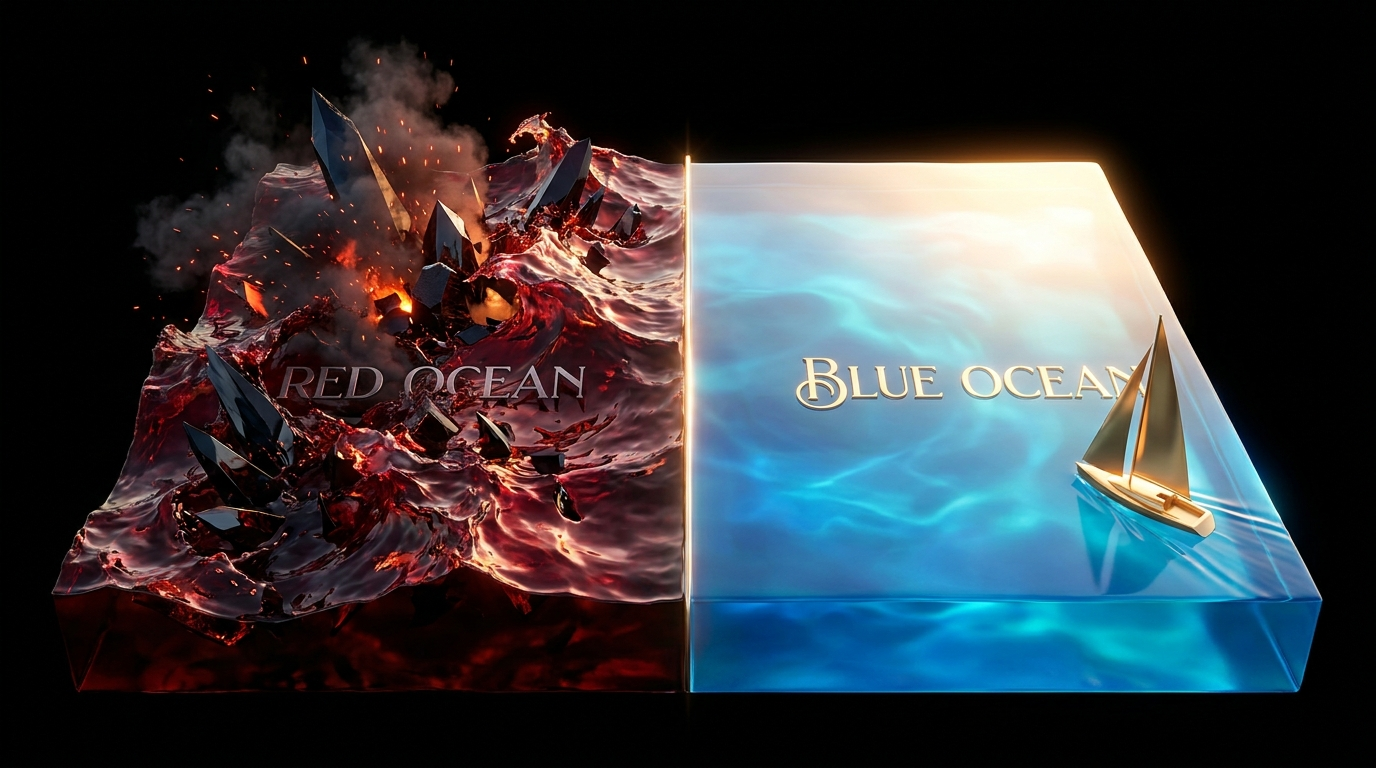
A Red Ocean refers to existing, well-known markets where industry boundaries are clearly defined and the rules of competition are established. In this space, companies fight to capture a larger share of a fixed or limited market by outperforming rivals. As competitors multiply, growth and profit opportunities shrink, and eventually competition turns into a bloody battle over price — exactly where the name “red ocean” comes from.
In this environment, products quickly become commodities, differentiation between brands fades, and customers decide purely based on price. Budget airlines, generic fast-food chains, or online stores with no distinct identity are clear examples of this condition.
What Is a Blue Ocean?
In contrast, a Blue Ocean refers to fresh, untapped market space where intense competition has not yet formed. Instead of beating rivals, a company creates new demand and writes the rules of the game from scratch. This concept was first formally introduced in the book Blue Ocean Strategy, written by W. Chan Kim and Renée Mauborgne, professors at INSEAD business school.
Based on their research, which analyzed over a hundred years of industry data, companies that successfully create a blue ocean experience significantly more remarkable and sustainable growth compared to their red-ocean competitors. A famous example is Cirque du Soleil, which combined theatrical art with traditional circus performance to create an entirely new market — one that competed neither with traditional circuses nor classical theater, but instead built a space between the two with no direct rival.

The Fundamental Difference Between These Two Approaches
1. Strategic Focus
In a red ocean, the primary focus is on competitors and beating them. In a blue ocean, the focus shifts to the customer and creating value that no one else has offered yet. This difference in focus directly affects how resources are allocated, R&D priorities, and even organizational culture.
2. The Value-Cost Logic
One of the most important tools in this framework is a concept called Value Innovation — simultaneously reducing costs while increasing value for the customer. Traditionally, it was assumed that a business had to choose between “low cost” and “high differentiation.” But Kim and Mauborgne proved both can be achieved together, if a company redefines its industry’s boundaries instead of competing within the existing framework.
3. Market Size
In a red ocean, companies fight to capture a share of a market with a fixed size. In a blue ocean, the total market size grows, since new demand is created that didn’t exist before. Instead of dividing a fixed pie among more competitors, a bigger pie is baked altogether.
4. Time Horizon and Sustainability
Competitive advantage in a red ocean is usually short-lived, as rivals quickly imitate any innovation. But the space created in a blue ocean, due to its novelty, remains protected from imitation for a longer period, providing enough time to establish a strong market leadership position.
Why Does This Framework Matter Today?
In a world saturated by digital competition, nearly every industry faces a flood of similar rivals. From advertising agencies to tech startups, everyone offers strikingly similar propositions. In such conditions, trying to be “better” than competitors within the same game ultimately leads to resource depletion. The Strategy Canvas tool, introduced within this same framework, helps businesses map their industry’s competitive factors and identify which ones can be eliminated, reduced, raised, or created to break free from this cycle.
This is exactly the same framework explored in detail in our article What Is Brand Positioning?, since successful positioning is the essential prerequisite for entering a blue ocean. If a brand cannot secure a distinct position in the customer’s mind, even an innovative product will eventually be pulled toward price competition.
Practical Steps Toward a Blue Ocean
Step 1: Map Your Industry’s Strategy Canvas
Start by listing the primary competitive factors of your industry — factors every rival invests in, such as price, service speed, or product variety. Then determine which of these factors genuinely create value for customers and which merely persist out of industry habit.
Step 2: Apply the Four Actions Framework
Kim and Mauborgne introduced a framework called the “Four Actions Framework,” built around four key questions: Which factors should be eliminated? Which should be reduced well below industry standard? Which should be raised well above industry standard? And what entirely new factors should be created? Precise answers to these four questions illuminate the path toward value innovation.
Step 3: Focus on Non-Customers
A key aspect of this strategy is paying attention to those who are not yet customers of your industry — people who, for various reasons, don’t use existing products. Discovering the reasons behind this non-use often provides valuable clues for creating new markets.
Step 4: Test and Implement Gradually
Moving toward a blue ocean should never happen overnight without testing. It’s better to first test new hypotheses on a small scale, gather real market feedback, and then scale up execution with greater confidence.

A Real-World Example: Rahkar and the Betta Fish
At Rahkar agency, the brand’s visual identity is built around the symbol of a Betta fish — a creature that, unlike many marine species that swim in large, similar-looking schools, typically lives alone in its own territory and immediately draws attention with its vivid colors. This symbol perfectly reflects the philosophy of blue ocean strategy: instead of getting lost among a sea of similar competitors, create a unique space for yourself where you shine, uncontested.
The Rahkar Business Agency team applies this exact framework in its strategic consulting process — from mapping industry competitive landscapes to identifying untapped market opportunities. This process typically begins with an honest assessment: is your business currently swimming in a red ocean?
Common Mistakes on the Path to Creating a Blue Ocean
Many businesses make mistakes while trying to create a blue ocean that undermine their success:
Confusing technological innovation with value innovation: Many assume that simply using new technology is enough, whereas blue ocean strategy is about creating real value for customers, not necessarily advanced technology.
Overemphasizing differentiation while ignoring cost: Some companies focus so heavily on being different that they neglect their cost structure, ultimately making their business model unsustainable.
Insufficient testing before major investment: Some businesses make massive investments without testing their hypotheses on a small scale first, dramatically increasing the risk of failure.
Assuming a blue ocean stays uncontested forever: Every blue ocean, due to its own success, eventually attracts new competitors over time and gradually turns into a red ocean; therefore, innovation must be a continuous process, not a one-time action.
Conclusion
The difference between blue ocean and red ocean strategy is not merely an appealing metaphor — it’s a practical framework that can redefine the future of any business. Companies that learn to create new demand instead of fighting over existing market share not only escape the erosion of price competition but also experience more sustainable and profitable growth.
This path requires careful industry analysis, deep customer understanding, and the courage to redefine the rules of the game. If your business feels trapped in the endless cycle of price competition, the Rahkar Agency team is ready to help chart your course from the red ocean toward the blue ocean, guiding your brand into a distinct and uncontested space.
Sources:
- W. Chan Kim & Renée Mauborgne — Blue Ocean Strategy, Harvard Business Review Press
- INSEAD Business School — Original research on blue ocean strategy
- Harvard Business Review — Analytical articles on value innovation and competitive strategy
- What Is Brand Positioning? — Related article by Rahkar Agency
To learn more about business models and professional strategic planning tools, explore this globally recognized resource: