
What Is User Experience (UX)
I once sat in a meeting with the CEO of a large textile brand based in Isfahan. He spoke proudly about the substantial budget he’d invested in his logo and visual identity. And honestly, the logo was beautiful — balanced colors, precise typography, everything textbook-perfect according to branding principles. But when I opened his company website, within five seconds I had no idea where I was on the page. The menu was scattered, the “Contact Us” button appeared in three different places with three different colors, and finding a simple product catalog took seven clicks.
This is exactly where user experience enters the picture — the point where all the visual polish of a brand becomes meaningless if it isn’t paired with a smooth, logical experience.
What Is User Experience, Really?
The simplest way to put it: user experience, or UX, refers to how a person feels when interacting with your product, service, or website. That feeling encompasses everything — from how fast a page loads to whether your contact form actually works, from button colors to the path a user takes to reach their goal.
A lot of people confuse UX with UI (user interface). While related, they’re not the same thing. UI is about appearance — colors, fonts, icons. UX is about feeling and function — how easily a user gets what they came for. You can have a strikingly beautiful website that delivers a terrible experience, exactly like that textile brand I mentioned.
Why Do Most Businesses Overlook User Experience?
Over years of working in brand strategy and business consulting, I’ve noticed a recurring pattern: businesses typically spend their budget first on advertising and marketing, then on graphic design, and if anything’s left over, user experience gets whatever remains. This order is backwards, and the result is predictable — users get attracted, land on the site, and then leave without buying or reaching out.
This oversight usually comes down to one of three things:
- UX isn’t something you notice at a glance — you have to live through it to understand it.
- Many business owners assume beautiful design automatically means good experience.
- Measuring UX’s direct ROI is harder than measuring the results of an ad campaign.
But the reality is that user experience is one of the most direct levers you have over conversion rates, customer trust, and ultimately, sales.
UX and Your Brand: More Than Just a Pretty Website
Here’s something that often gets missed: user experience is inseparable from your brand identity. When we talk about brand persona, we’re really talking about the personality your brand builds in a customer’s mind. That persona isn’t shaped only by words and images — it’s shaped by every interaction a user has with your brand, including the experience they have while browsing your site.
Say your brand claims to be “professional” and “trustworthy.” But your site loads slowly, has broken links, and your contact form doesn’t work. The user feels this contradiction, even if they can’t articulate exactly what’s wrong. This is precisely where your brand positioning in the customer’s mind ends up becoming the exact opposite of what you intended to build.

What Does Good User Experience Actually Look Like?
After years working on various projects — including strategic branding consultations and behavioral analysis of users across industrial and service-based websites — we’ve come to a conclusion: good UX usually revolves around a few simple but fundamental principles.
1. Clarity Beats Creativity
It might sound strange, but in UX design, clarity always outranks creativity. When a user lands on your site, they’re looking for one thing: a fast answer to a question or need. If the path to that answer is complicated or vague, you’ll lose them — even if your site design has won awards.
2. Speed Isn’t a Feature. It’s a Requirement
Multiple studies in the UX field show that if a page takes more than three seconds to load, over forty percent of users abandon it. For businesses paying heavily to drive traffic to their site, that number is catastrophic.
3. Mobile Compatibility Is No Longer Optional
In the Iranian market, a significant portion of website traffic comes through mobile devices. If your site struggles on mobile, you’ve effectively lost half your potential audience.
4. Logical Visual Hierarchy
A user’s eye needs to know where to look first, and where next. This means headlines, call-to-action buttons, and key information need to sit in positions that naturally draw attention — not get lost in a sea of text and imagery.
UX and Your Value Proposition: A Two-Way Relationship
When we talk about a brand’s value proposition, the conversation is usually about why customers should choose you over competitors. But something often forgotten is this: your value proposition, no matter how strong, becomes practically useless if it isn’t properly delivered through your website’s user experience.
Say your value proposition is “the fastest delivery service in Isfahan,” but users have to spend five minutes hunting through your site just to find contact information or an order form. You’re essentially creating a direct contradiction between what you say and what you deliver. Users subconsciously pick up on this contradiction, and trust erodes.
UX in Service of Blue Ocean Strategy
One principle we hold firmly at Rahkar Agency is that genuine differentiation doesn’t come from product or price alone — it also comes from the experience you deliver to customers. When we talk about blue ocean strategy, we’re really talking about creating a space where direct competition becomes irrelevant, because you’re offering something fundamentally different.
User experience can play exactly that role. In a market where most of your competitors run slow, cluttered, confusing sites, offering a simple, fast, smooth experience is itself a kind of blue ocean. Users may not be able to articulate exactly why they prefer your site, but the sense of ease they feel is what brings them back.
Branding vs. Marketing — And Where UX Fits In
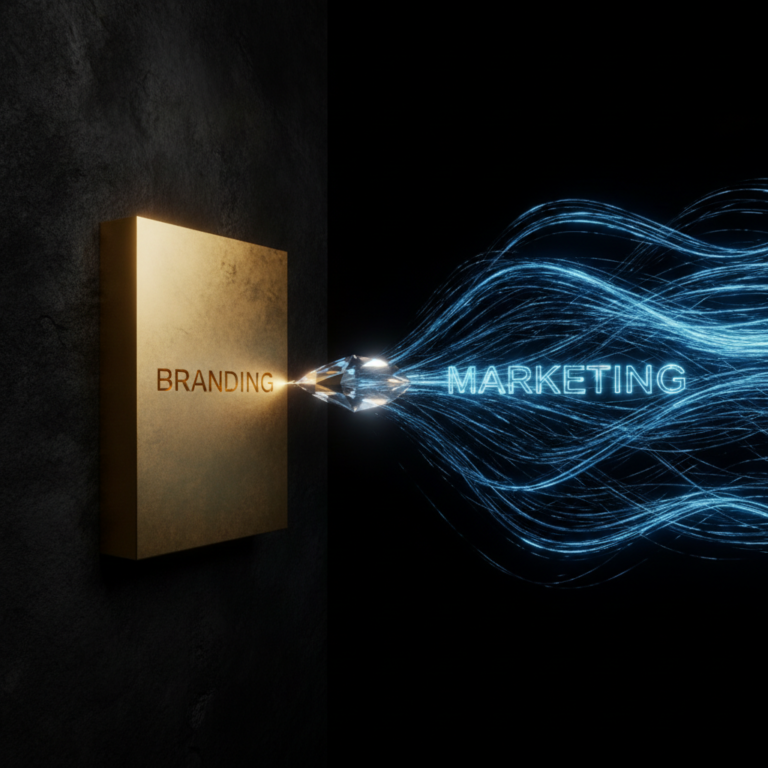
In an earlier piece we wrote about the difference between branding and marketing, we pointed out that marketing is usually about acquiring customers in the short term, while branding is about building a meaningful, lasting relationship over time. User experience sits precisely at the intersection of these two.
A great advertising campaign can bring a user to your site (marketing), but it’s the user experience that determines whether that user becomes a loyal customer of your brand (branding). This is exactly why, at Rahkar, we never treat these two domains as separate.
Common Mistakes That Destroy User Experience
Having audited dozens of different websites, we’ve noticed certain mistakes show up with striking regularity:
- Long, unnecessary forms: Don’t ask users for information you don’t genuinely need.
- Intrusive pop-ups: Sudden windows that interrupt the user’s experience usually cause more harm than good.
- Unclear pricing or checkout process: If users have to call you just to find out a price, in many cases, you lose them right there.
- No clear next step: Every page should guide the user toward a specific next action.
How Can You Actually Improve Your Website’s UX?
Contrary to popular belief, improving UX doesn’t require a full site redesign. It usually starts with small, deliberate steps.
First, start with analyzing actual user behavior. Tools like heatmaps can reveal where users click most and where they abandon the page — data that often reveals realities you’d never have guessed on your own.
Second, see the user’s journey through their eyes, not the designer’s or business owner’s. What seems obvious to us is often completely unclear to a first-time visitor.
Third, test every change. Even something as small as a button color or the placement of a form can have a measurable impact on conversion rates.
Final Thoughts
User experience might seem, at first glance, like a purely technical or specialized subject. But at its core, it’s one of the most human parts of building a brand. It’s about respecting your customer’s time and attention — about telling them, “we understand what you need, and we’ve made the path to getting it simple.”
At Rahkar Agency, we don’t see user experience as separate from branding and business strategy. For us, your website isn’t just a digital storefront — it’s part of the story your brand tells its customers. If you suspect your current site isn’t telling that story properly, maybe it’s time to look at the experience you’re offering your customers again — this time, through a strategic lens.
Sources
Nielsen Norman Group
One of the most authoritative global references on user experience and interaction design, backed by decades of field research on user behavior.
Google Search Central – Core Web Vitals
Google’s official guide on the technical speed and UX metrics that directly impact your site’s search ranking.
Interaction Design Foundation
A comprehensive resource for learning UX principles from the ground up, with expert courses and in-depth articles.
Strategyzer
World-recognized tools and methodologies for designing value propositions and business models, aligned with brand experience.
Rahkar | Related Articles
For a deeper dive into brand persona, value proposition, and blue ocean strategy, explore Rahkar’s specialized article series.