
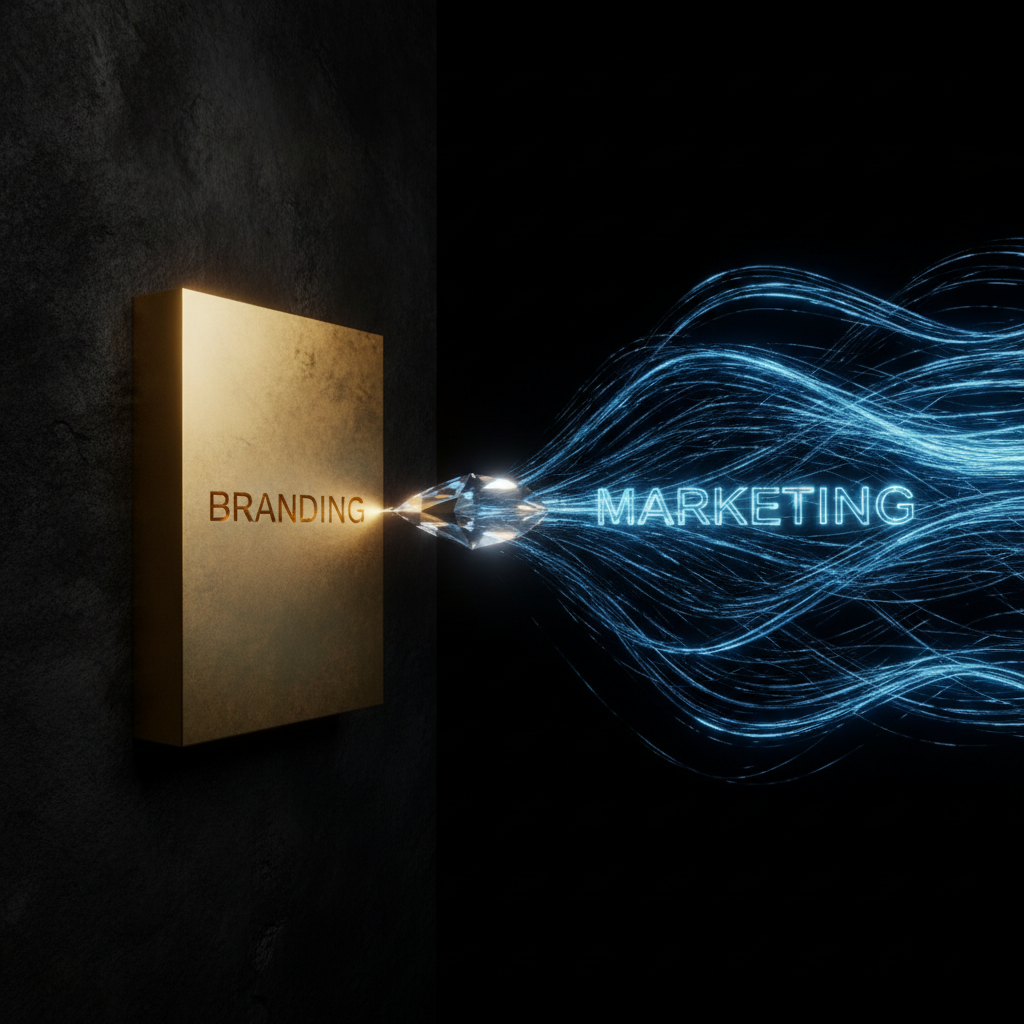
Branding vs Marketing: What’s the Real Difference?
Most business owners, when they want to grow, do the same thing first: set aside a budget for ads and campaigns. Months later, despite heavy spending, the results still don’t show up. Why?
Because in most cases, the problem isn’t marketing — it’s the absence of a clear, differentiated brand. And this brings us to the real question: what is the actual difference between branding and marketing?
What Is Branding?
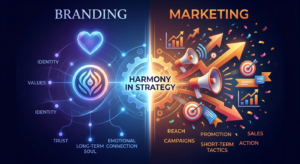
Branding is the process of building the identity, personality, and position a business holds in the mind and heart of its audience. Branding answers questions like: “Who are we?”, “What do we stand for?”, and “Why should people trust us?”
Branding includes elements such as logo, color palette, tone of voice, brand story, and the experience customers get at every touchpoint. Branding is a long-term, deeply emotional process.
What Is Marketing?
Marketing is a set of activities and tactics used to introduce, promote, and sell a product or service. Marketing answers the question: “How do we get our product in front of the right audience?”
Marketing includes advertising campaigns, SEO, social media, email marketing, and paid ads. Unlike branding, marketing is typically shorter-term and more measurable.
The Core Difference Between Branding and Marketing
1. Branding Is the “Why,” Marketing Is the “How”
Branding is your reason for existing and the value you offer; marketing is the vehicle that delivers that value to the market. As Seth Godin, renowned marketer and author, put it: “A brand is the set of expectations, memories, stories, and relationships that, taken together, account for a consumer’s decision to choose one product or service over another.”
2. Different Time Horizons
Branding is a long-term investment whose results gradually unfold over years. Marketing, on the other hand, is usually designed to achieve short-term goals, such as boosting seasonal sales or launching a new product.
3. Position in the Marketing Funnel
According to the Marketing Funnel model, branding primarily operates at the top of the funnel (awareness and perception) and partly at the bottom (loyalty), while marketing is more active in the middle of the funnel (interest, consideration, and decision).
4. Measurability
Marketing results can be measured quickly through metrics like click-through rate, conversion rate, and ROI. Branding’s impact, however, is often reflected in more qualitative indicators such as customer loyalty, perceived value, and brand awareness.
Why Are These Two Concepts Often Confused?
Many businesses believe that if they have a beautiful logo and an attractive ad campaign, their brand is strong. But the truth is, a beautiful logo without a clear brand strategy is like an elegant outfit without a fitting body underneath — it looks appealing, but lacks substance.
On the other hand, many marketing teams jump straight into campaign execution without a defined brand identity. The result? Scattered, inconsistent messaging with no lasting impact.
How Should Branding and Marketing Work Together?
1. Branding Is the Foundation, Marketing Is the Execution Tool
Brand identity, core values, and messaging must be defined first; only then can the marketing team design effective campaigns based on that framework.
2. Consistent Messaging Across All Channels
From your website to social media and paid ads, your brand message must remain consistent and recognizable. This consistency builds customer trust.
3. Combined Measurement
Real success happens when both short-term marketing metrics (sales, traffic, conversions) and long-term branding metrics (loyalty, credibility, awareness) are tracked simultaneously.
A Simple Analogy
Imagine your brand as a Betta fish — a distinct, remarkable creature that instantly stands out in an ocean full of similar fish. Branding is what makes this fish different from the rest: its color, its movement, its presence. Marketing, however, is the ocean water in which this fish swims and gets shown to others. Without strong branding, even the best marketing can’t help the fish stand out among countless competitors.
Conclusion
Branding and marketing are two sides of the same coin, not competitors. Branding tells the world who you are, and marketing helps you get seen. Businesses that clearly separate these two concepts while aligning them in execution will build a sustainable growth path that stands apart from the competition.
Sources:
- Seth Godin — This Is Marketing, Penguin Portfolio
- David Aaker — Building Strong Brands, Free Press
- Kotler, P., & Keller, K. L. — Marketing Management, Pearson
- Harvard Business Review — Articles and research on branding and marketing
To learn more about business models and professional strategic planning tools, explore this globally recognized resource: