How to Build a Brand Strategy| Rahkar Agency
Abstract: Building a brand strategy is not about designing a logo or writing a tagline. It is a structured decision-making process that determines how your business competes, communicates, and grows. This guide by Rahkar Agency walks through the essential phases of brand strategy development — from market analysis to positioning, identity, and execution — with a focus on what actually works in competitive markets.
Why Most Brand Strategies Fail Before They Start
Here is a pattern that repeats itself constantly: a business invests in a new logo, launches a website, runs some ads — and then wonders why nothing sticks. The problem is almost never the execution. It is the absence of a strategy underneath it all.
A brand strategy is the foundation that makes every marketing decision coherent. Without it, you are spending money on tactics that pull in different directions. With it, every touchpoint — from a social media post to a sales conversation — reinforces the same core message and builds the same perception in the customer’s mind.
At Rahkar Agency, we have worked with businesses across industries and the single most common gap we find is not a lack of budget or talent. It is the absence of a clear, documented brand strategy. This guide is our attempt to change that.
Phase 1: Honest Self-Assessment Before Anything Else
Before you can define where you want to go, you need an honest picture of where you are. This means conducting a brand audit — not a surface-level review, but a genuine examination of:
- How your current customers actually describe you (not how you describe yourself)
- The consistency of your messaging across all channels
- The gap between your intended brand perception and the actual one
- Where your visual and verbal identity is working and where it is creating confusion
The data from this phase is often uncomfortable. That is exactly why it is valuable. Businesses that skip this step tend to build strategies on assumptions rather than reality — and those strategies rarely survive contact with the market.

Phase 2: Market and Competitive Intelligence
Understanding your competitive landscape is not about copying what works for others. It is about finding the spaces they have left open.
Effective competitive analysis at this stage involves mapping out the positioning of key competitors — what promises they make, what audiences they target, what emotional territory they occupy. The goal is to identify genuine differentiation opportunities, not just surface-level differences.
One framework we find particularly useful at Raahkar is the Blue Ocean Strategy approach, which focuses on creating uncontested market space rather than competing in overcrowded segments. You can explore this concept further in our article on Blue Ocean Strategy.
The output of this phase should be a clear picture of the competitive map and a hypothesis about where your brand can occupy a meaningful, defensible position.
Phase 3: Defining Your Target Audience With Precision
Broad targeting is not targeting. “Our audience is anyone who needs our product” is a statement that guarantees mediocre marketing and weak brand recall.
Defining your target audience means going beyond demographics into psychographics — the values, fears, aspirations, and decision-making patterns of the specific people you are trying to reach. The questions that matter here are:
- What does your ideal customer believe about the world?
- What problem keeps them up at night that you can solve?
- What does success look like for them — and how does your brand fit into that picture?
- Where do they go for information and who do they trust?
This depth of understanding is what makes the difference between a brand that resonates and one that is simply visible. It also directly informs your brand persona — the personality, tone, and communication style your brand adopts to connect authentically with this audience. Read more about this in our guide on Brand Persona Development.
Phase 4: Crafting a Value Proposition That Earns Attention
Your value proposition is the single most important sentence your brand will ever communicate. It answers the question every potential customer is silently asking: “Why should I choose you over everyone else?”
A strong value proposition is:
- Specific: It names a real problem and a real solution, not vague benefits
- Differentiated: It highlights what makes you genuinely different, not just better
- Credible: It makes a claim you can actually back up with evidence
Most value propositions fail because they focus on features rather than outcomes, or they make claims that every competitor could make equally. The test of a good value proposition is simple: could your closest competitor say the exact same thing? If yes, it needs more work.
For a deeper dive into designing a compelling value proposition, visit our dedicated guide: What Is a Value Proposition and How to Design One.

Phase 5: Brand Positioning — Owning a Place in the Customer’s Mind
Positioning is not what you do to a product. It is what you do to the mind of a prospect. The goal is to own a specific, meaningful, and defensible idea in the mental landscape of your target audience.
Effective brand positioning requires three things to be true simultaneously:
- It must be relevant to your target audience — they must actually care about the territory you are claiming
- It must be differentiated from competitors — you cannot own a position someone else already occupies
- It must be credible — your business must be able to consistently deliver on the promise the position implies
The classic tool here is the positioning statement, but we encourage businesses to think beyond the statement itself. Positioning is a living commitment that must be reflected in every product decision, every hire, every piece of content, and every customer interaction. Read more in our article on Brand Positioning Strategy.
Phase 6: Building the Brand Identity System
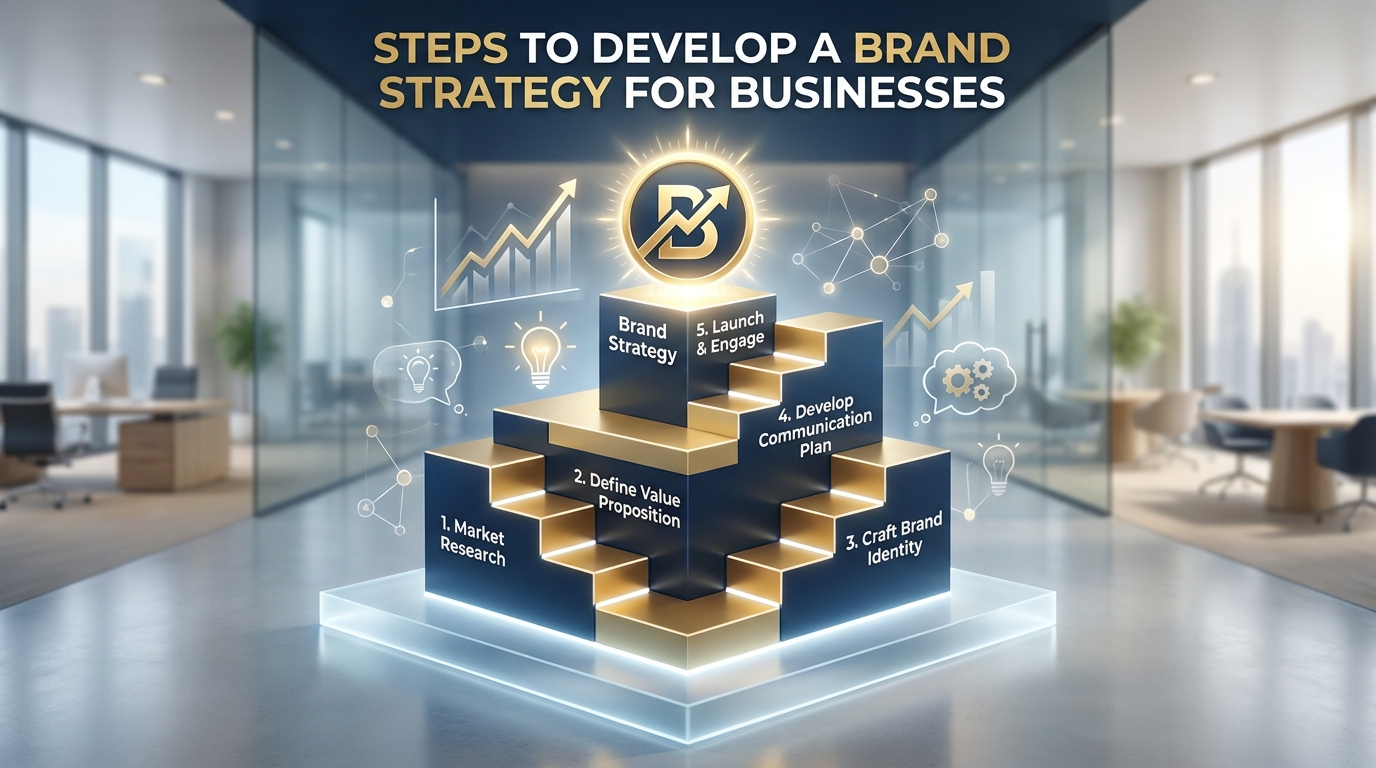
With strategy defined, you can now build the identity system that expresses it. This is where most people think branding starts — but as you can see, it is actually Phase 6 of an eight-phase process.
A complete brand identity system includes:
- Visual identity: logo, color palette, typography, iconography, photography style, and layout principles
- Verbal identity: brand voice, tone guidelines, key messages, and naming conventions
- Brand story: the narrative that explains why the brand exists and what it stands for
- Brand guidelines: the documented rules that ensure consistency across every application
The most important word in brand identity is consistency. A brand that looks one way on its website, sounds different on social media, and behaves differently in sales conversations is not a brand — it is a collection of disconnected impressions. Consistency is what transforms individual touchpoints into cumulative brand equity.
Phase 7: Go-to-Market Communication Strategy
A brand strategy without a communication plan is a document that sits in a folder. This phase translates strategy into action by defining:
- Which channels reach your target audience most effectively
- What content formats and topics build authority in your space
- How frequently and consistently you show up across each channel
- How you measure whether your communication is building the intended brand perception
In practice, this means aligning your content marketing, SEO strategy, social media presence, and paid media around a single coherent brand narrative. Every piece of content should answer the question: does this reinforce the position we are trying to own?
At Rahkar Agency, we build 360-degree digital marketing campaigns that keep this alignment intact from strategy through execution — ensuring that the brand story told in a blog post is the same one told in a retargeting ad or a sales email.
Phase 8: Measurement, Learning, and Evolution
Brand strategy is not a one-time project. Markets shift, competitors respond, customer expectations evolve, and your own business grows into new capabilities. A brand strategy that does not evolve becomes a constraint rather than an asset.
Building in regular review cycles — quarterly for communication performance, annually for strategic positioning — ensures your brand stays relevant without losing the consistency it has built. Key metrics to track include:
- Unaided brand awareness among your target segment
- Net Promoter Score and customer sentiment trends
- Share of voice in your category
- Conversion rates at key funnel stages (a proxy for message-market fit)
- Organic search visibility for brand and category keywords
The brands that win over the long term are not those that got their strategy perfect on the first try. They are the ones that built a system for learning and adapting while keeping their core identity intact.
How Rahkar Agency Approaches Brand Strategy
Rahkar is a strategy-first business agency based in Isfahan, Iran. Our work sits at the intersection of brand strategy, digital marketing, and business consulting — and our approach is built on one conviction: that sustainable business growth requires a clear, differentiated brand at its foundation.
We work with businesses at every stage — from startups defining their identity for the first time to established companies repositioning for new markets. What stays constant is our process: structured, evidence-based, and focused on outcomes that are measurable, not just impressive-sounding.
If you are ready to build a brand strategy that actually moves your business forward, we would be glad to start the conversation.
Conclusion
Brand strategy development is an eight-phase process that begins with honest self-assessment and ends with a commitment to continuous measurement and evolution. Each phase builds on the last, and skipping any one of them creates a gap that will eventually show up as inconsistency, weak differentiation, or missed growth opportunities.
The businesses that invest in this process — that take the time to understand their market, define their audience, articulate their value, and build a consistent identity around it — are the ones that compound brand equity over time. And brand equity, ultimately, is one of the most durable competitive advantages a business can build.