
Growth vs Scaling: What You Must Know | Rahkar Agency
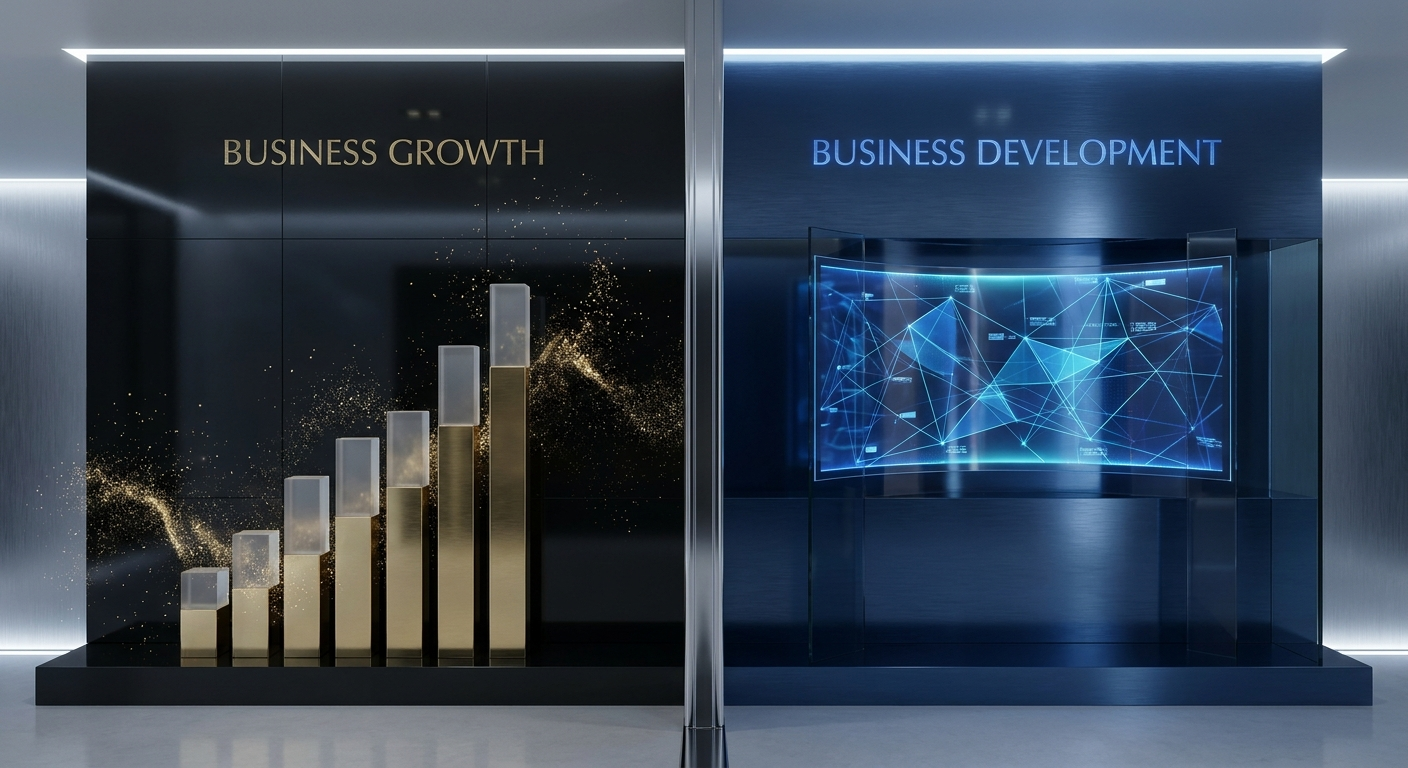
Growth vs Scaling: The Strategic Difference That Changes Everything
Every founder eventually reaches a point where the business is working, customers are coming in, and the question shifts from “will this survive?” to “how do we get bigger?” That question sounds simple. It isn’t.
There are two fundamentally different answers: grow, or scale. They look similar from the outside. They feel similar in the early stages. But they lead to completely different financial realities, organizational structures, and long-term outcomes.
At Rahkar Agency, we’ve worked with businesses across industries, and one of the most consistent patterns we see is this: companies that confuse growth with scaling either burn out trying to grow linearly forever, or they try to scale before they’re ready and collapse under the weight of their own ambition.
Defining Growth
In business, growth means your revenue increases — but so do your costs, at roughly the same rate. You hire more people to serve more customers. You open more locations to reach more markets. You buy more inventory to fulfill more orders.
Growth is linear. It’s predictable. And it has a ceiling.
- Revenue and costs scale together
- Profit margins stay relatively flat
- Human capital is the primary bottleneck
- Expansion requires proportional investment
- Risk increases with size
Defining Scaling
Scaling means your revenue grows significantly faster than your costs. The classic example is software: you build a product once and sell it to one customer or one million customers — the marginal cost of each additional customer is near zero.
- Revenue grows faster than costs
- Profit margins improve with size
- Systems and technology replace manual effort
- The business becomes less dependent on any single person
- Value compounds over time

The Core Metric: Cost-to-Revenue Ratio
| Metric | Growth | Scaling |
|---|---|---|
| Revenue doubles | Costs ~80–100% increase | Costs ~20–40% increase |
| Headcount | Grows with revenue | Grows slowly |
| Profit margin | Flat or declining | Improving |
| Resource dependency | High | Low |
Why Businesses Get This Wrong
Mistake 1: Scaling before product-market fit. A business that hasn’t proven why customers buy, who their real customer is, and what makes them different has no business trying to scale. Scaling amplifies what already exists — if what exists is broken, scaling breaks it faster and more expensively. Before you think about scaling, you need clarity on your brand strategy.
Mistake 2: Growing forever without a scaling plan. Some businesses stay in growth mode so long that they never build the systems, technology, or brand equity needed to scale. By the time they want to transition, margins have been squeezed and there’s no capital left to invest.
Mistake 3: Confusing activity with leverage. Hiring more salespeople is growth. Building a content engine that generates inbound leads while you sleep is scaling.
The Role of Brand in Scaling
You cannot scale a weak brand. When you’re small, you can rely on personal relationships and word of mouth. When you scale, you need a brand that works without you in the room. A well-defined brand positioning:
- Reduces customer acquisition costs
- Increases conversion rates
- Enables premium pricing
- Makes hiring easier
Business Models Built for Scaling
- Subscription models — Recurring revenue, amortized acquisition cost
- Platform models — Value increases with network size
- Digital products — Created once, sold repeatedly
- Licensing and franchising — Systems and brand as the product
- Content and media — Compounding returns over time
When to Grow and When to Scale
Grow when: your model isn’t fully proven, you’re still learning who your best customers are, processes aren’t documented, or you lack capital for scaling infrastructure.
Scale when: you have clear product-market fit, documented and teachable processes, demand consistently exceeds capacity, and healthy margins to fund investment.
Are You Ready to Scale? A Practical Checklist
- ✓ Product-market fit confirmed — Repeat customers and unsolicited referrals
- ✓ Documented processes — A new hire can follow your playbook
- ✓ Healthy margins — Room to invest without going negative
- ✓ Clear brand identity — Brand positioning sharp enough to work without you
- ✓ Identified leverage point — You know which part can grow without proportional cost increases
Blue Ocean Strategy and Scaling
Businesses operating in blue ocean spaces have significantly better scaling economics. When you’re not competing on price, margins stay healthier, customers are more loyal, and the unit economics of scaling actually work in your favor.
Conclusion
The difference between growth and scaling isn’t just academic — it’s the difference between building a business that works harder every year and building one that works smarter. Growth gets you to viability. Scaling gets you to value.
The most successful businesses Rahkar Agency has worked with grew deliberately until their model was proven, then scaled strategically once the foundation was solid. They treated growth as the testing phase and scaling as the multiplication phase.
If you’re unsure which phase your business is in, that’s exactly the kind of question Rahkar Agency exists to answer.
Further Reading
Deepen your understanding of business scaling and growth strategy with these authoritative resources:
- Blank, Steve & Dorf, Bob — The Startup Owner’s Manual
- Hoffman, Reid — Blitzscaling
- Osterwalder, Alexander — Business Model Generation
- Kim, W. Chan & Mauborgne, Renée — Blue Ocean Strategy