

brand-analysis-famous-brands and Their Strategies
In competitive markets, customers do not buy products only because of features or price. They buy confidence, relevance, identity, and trust. This is why the Analysis of famous brands is more than an academic exercise. It is a practical way to understand how strong businesses become unforgettable.
The world’s leading brands were not built by accident. They were shaped through strategic decisions, long-term consistency, sharp audience insight, and the ability to create a clear place in the minds of customers. While each brand has its own path, many of them share common patterns that businesses of any size can learn from.
For readers interested in branding, content, and digital positioning, related Raahkar topics such as
Case Study of Raahkar Projects
and
Content Strategy Guide
can also provide useful context.
What Is a Brand, Really?
A brand is not just a logo, a slogan, or a color palette. A brand is the total perception people have about a business. It is what they expect, what they feel, and what they remember when they hear its name. Advertising may attract attention, but branding shapes long-term meaning.
A strong brand usually has a clear promise, a recognizable identity, a consistent voice, and a differentiated value in the market. If the visuals look polished but the customer experience feels confusing or inconsistent, the brand weakens over time. This is why professional branding must go far beyond appearance.
At this level, branding connects naturally with website experience, SEO, content strategy, communication style, and customer interaction. That integrated mindset is exactly what separates ordinary businesses from memorable ones.
Apple: Turning Simplicity into Competitive Advantage
Apple is one of the strongest examples in branding history. The company built its global reputation not only through innovation, but through a disciplined commitment to simplicity, clarity, and refined customer experience. Apple products feel intuitive, elegant, and controlled. That feeling is part of the brand itself.
One of Apple’s key strengths is its ability to hide complexity behind a seamless interface. Customers do not need to understand the technical depth behind the product. They only need to experience the sense of ease. This design philosophy has become central to Apple’s market position.
Apple is also exceptionally consistent in communication. Product launches, retail spaces, packaging, website design, and visual language all support the same message: premium, simple, intelligent. The lesson here is powerful: a great brand does not need to say everything. It needs to say the right thing, clearly and consistently.
Nike: Selling Identity Instead of Products
Nike is one of the clearest examples of identity-driven branding. Its legendary slogan, Just Do It, is not simply a line of copy. It captures a mindset. Nike does not position itself as a seller of shoes or clothing; it positions itself as a symbol of effort, confidence, and action.
That is why Nike’s branding feels bigger than its products. The company consistently connects itself to ambition, personal progress, resilience, and emotional strength. Athlete partnerships help, but the true power of Nike lies in how those figures become part of a larger narrative rather than isolated endorsements.
For businesses working on their market position, this is a critical lesson: customers often choose brands not because of technical superiority alone, but because the brand expresses a version of who they want to become. This is where strategic branding work, such as the kind associated with Raahkar Agency, becomes essential.
Coca-Cola: Emotion, Familiarity, and Consistency
Coca-Cola is one of the most recognizable brands in the world, and its success offers an important reminder: not every iconic brand wins through innovation alone. Sometimes, long-term emotional consistency is more powerful than constant reinvention.
Coca-Cola is deeply associated with happiness, sharing, celebration, and everyday moments of connection. The red visual identity, the familiar tone, and the recurring emotional campaigns all reinforce the same basic idea. This repetition is not boring; it is strategic. It builds memory.
Many brands change their message too often and never become mentally anchored in the audience’s mind. Coca-Cola shows the opposite approach. When a brand knows what emotional territory it owns and keeps reinforcing it over time, it becomes culturally embedded.
Tesla: Innovation, Vision, and Rule-Breaking
Tesla stands out because it redefined what its category could mean. It did not merely sell electric cars. It sold a vision of the future. The brand became associated with technological progress, environmental ambition, bold thinking, and disruption.
What makes Tesla especially interesting is its ability to generate attention without relying on traditional advertising models in the same way many competitors do. The brand’s narrative itself creates media value. Product launches, public statements, innovation milestones, and leadership visibility all contribute to the story.
Tesla teaches an important branding principle: differentiation often requires courage. A brand that wants to stand out cannot simply repeat industry habits. It needs to present a stronger point of view about where the market is going and why it matters.
IKEA: Accessible Design as a Brand Promise
IKEA built its identity around a deceptively simple promise: good design should be available to many people. That promise is reflected in everything the brand does, from product development and pricing to store layout and packaging.
The brilliance of IKEA lies in strategic coherence. The shopping experience, the flat-pack model, the do-it-yourself assembly process, and the visual communication all support the same brand idea: practical, attractive, affordable living. This coherence makes the brand easy to understand and easy to remember.
Many businesses make the mistake of thinking professionalism requires complexity. IKEA proves the opposite. A clear and practical promise, consistently delivered, can become a powerful source of brand strength.
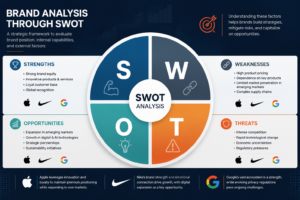
Common Patterns Among Famous Brands
When we compare famous brands across industries, several common patterns become visible. First, they all have a clear position. They know what they stand for and what they want to mean in the customer’s mind. Second, they maintain consistency. Their voice, visuals, message, and experience align over time.
Third, they create meaningful differentiation. They do not just look different; they offer a distinct value that customers can understand. Fourth, they rely on storytelling. People connect with narratives more deeply than with lists of product features. Fifth, they treat every customer touchpoint as part of the brand experience.
These patterns matter because they show that branding is not a decorative layer placed on top of a business. It is a strategic system that shapes how the business is perceived, remembered, and chosen.
What Businesses in Iran Can Learn
For Iranian businesses, branding is especially important because many markets are crowded, price-sensitive, and highly competitive. In such environments, a brand must do more than appear professional. It must create trust, clarity, and difference.
One key lesson is that positioning should come before promotion. If a business does not know what it wants to be known for, advertising will only amplify confusion. Another lesson is that not every message deserves equal weight. Strong brands focus. They choose a core promise and reinforce it consistently.
This is also where SEO and content become valuable. A business that publishes insightful, well-structured, search-friendly content can strengthen both visibility and authority. Articles such as
Branding and SEO
and
Business Growth Strategy
show how brand communication and search performance can support each other.
The Role of SEO and Content Strategy in Branding
Modern branding is no longer separate from digital discovery. When users search for a topic, a service, or a company name, the search results influence how that brand is perceived. A strong presence in search engines increases familiarity and trust, especially when the content is useful and authoritative.
Content is not just a ranking tool. It is a credibility tool. It teaches, clarifies, persuades, and positions the brand as a source of insight. A deep article can serve multiple functions at once: attracting traffic, building expertise, improving topical relevance, and shaping the reader’s perception of the brand.
This is why branding, SEO, and content strategy should not be treated as isolated departments. Businesses that integrate them effectively are more likely to achieve durable growth and stronger market recognition.
Conclusion: What Makes Great Brands Great?
The analysis of famous brands shows that great brands are not built by luck. They are built by strategic clarity, emotional relevance, consistency, differentiated value, and strong execution over time. Apple represents refined simplicity, Nike stands for ambition and movement, Coca-Cola owns emotional familiarity, Tesla embodies future-focused courage, and IKEA proves the power of practical accessibility.
The deeper lesson is this: successful brands do not just sell products. They occupy meaning. They stand for something people can recognize, trust, and remember. For any business that wants long-term growth, this matters far more than short-lived promotional tactics.
If your goal is to build a business that people do not just notice but truly remember, then studying famous brands is a smart place to begin. The next step is translating those lessons into a practical strategy for your own market, audience, and brand voice. That is where a structured approach, like the one associated with Raahkar and Raahkar Business Agency, can make a real difference.
English References
To learn more about brand strategy, brand valuation, positioning, marketing, and the strategies used by global brands, explore the following authoritative resources:
Interbrand
— Global brand consultancy and publisher of the Best Global Brands ranking
Brand Finance
— Independent reports and research concerning brand strength and brand valuation
Harvard Business Review
— Research-based articles covering brand management, leadership, strategy, and marketing
McKinsey – Growth, Marketing & Sales Insights
— Strategic insights concerning customer experience, growth, marketing, and commercial transformation
Think with Google
— Consumer insights, marketing trends, case studies, and digital strategy resources
Strategyzer
— Professional frameworks and tools for value propositions, business models, and innovation strategy
Nielsen Insights
— Data and insights concerning consumer behavior, audiences, media, and market performance
BrandingBusiness Insights
— Articles and strategic perspectives on branding, positioning, and business transformation
These external resources provide additional insights into branding, marketing, positioning, and global brand strategy.