
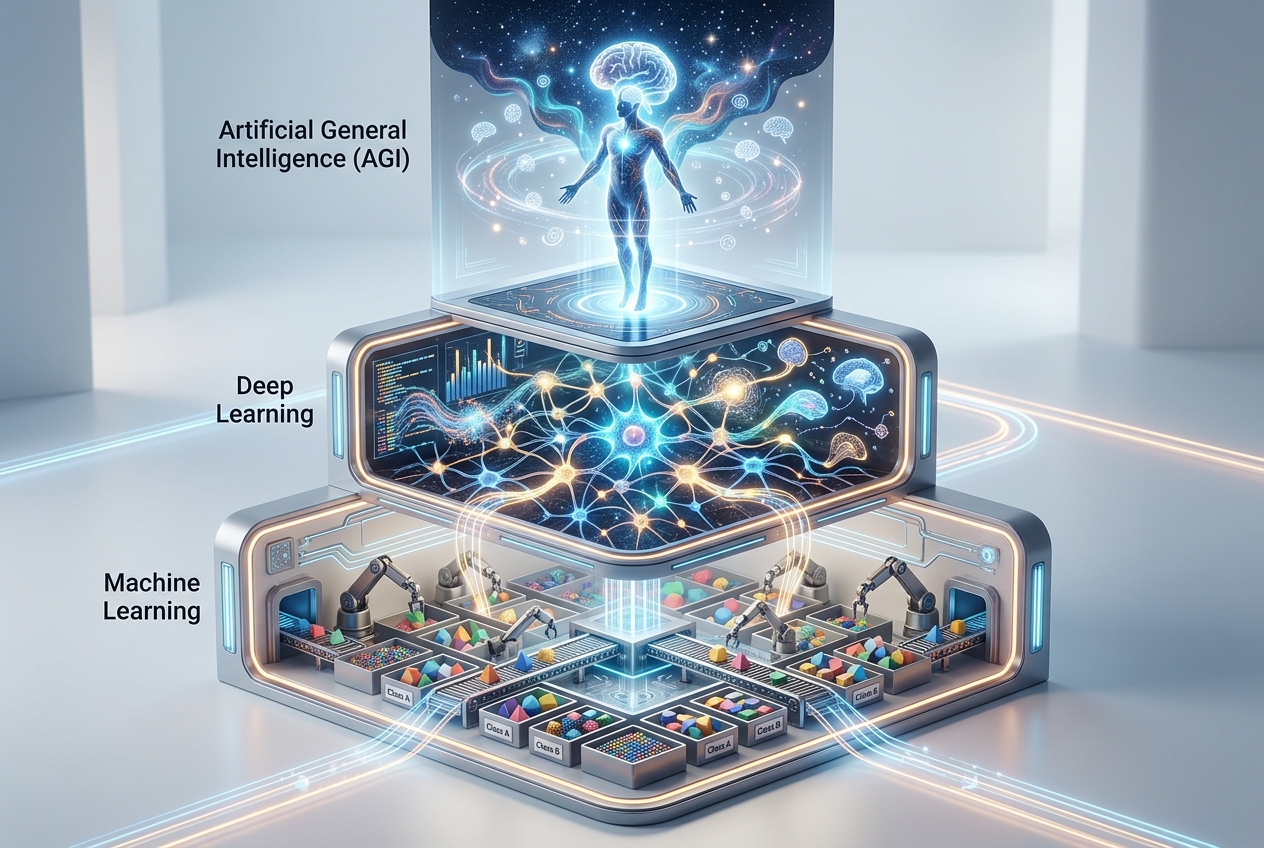
Machine Learning vs Deep Learning vs AGI: Key Differences Explained
Machine learning, deep learning, and AGI are often confused, but they represent very different levels of capability and maturity. This guide breaks down exactly how they differ — technically and strategically — and what that means for your business.
Machine Learning vs Deep Learning vs AGI: What Actually Separates Them
Every week, someone in a business meeting throws around “AI,” “machine learning,” and “deep learning” as if they mean the same thing. Then someone mentions AGI, and the confusion multiplies. If you run a business, manage a marketing team, or make technology decisions, this confusion isn’t harmless — it leads to wrong budgets, wrong vendor choices, and wrong expectations about what a tool can actually do for you.
This guide breaks down the real, technical, and practical differences between Machine Learning (ML), Deep Learning (DL), and Artificial General Intelligence (AGI) — not as abstract computer science trivia, but as concepts that directly affect how you evaluate AI tools, set realistic expectations, and make smarter decisions for your brand and marketing strategy.
The Nested Relationship: Why These Aren’t Separate Categories
Before diving into definitions, it helps to understand how these three concepts relate to each other structurally. They aren’t three parallel branches — they’re nested inside one another, like Russian dolls.
- Artificial Intelligence (AI) is the broadest umbrella — any system designed to perform tasks that typically require human intelligence.
- Machine Learning (ML) sits inside AI — a specific approach where systems learn patterns from data instead of following hand-coded rules.
- Deep Learning (DL) sits inside ML — a specific technique using multi-layered neural networks to learn especially complex patterns.
- AGI is not nested inside any of these. It’s a hypothetical future capability level — a system that would match or exceed human-level reasoning across virtually any cognitive task, not just the one it was trained for.
Understanding this hierarchy matters because it explains why “Is this AGI?” is the wrong question to ask about almost every AI tool on the market today, including ChatGPT, Midjourney, or any enterprise ML platform. None of them are AGI. All of them are Narrow AI, built using ML or DL techniques.
Machine Learning: The Foundation Layer
What Machine Learning Actually Is
Machine Learning is a method of building systems that improve their performance on a task by learning from data, rather than being explicitly programmed with fixed rules. Instead of a developer writing “if X, then Y” logic for every possible scenario, an ML algorithm is shown examples and learns the underlying pattern on its own.
A classic illustration: instead of programming rules to define what an email “spam” looks like, you feed an ML algorithm thousands of emails labeled “spam” or “not spam.” The algorithm identifies statistical patterns — certain words, sender behaviors, formatting quirks — and builds a model that can classify new, unseen emails with reasonable accuracy.
The Three Core Approaches to ML
Machine learning isn’t one technique — it’s a family of approaches, each suited to different types of problems:
- Supervised Learning: The model trains on labeled data — pairs of inputs and known correct outputs. Common business applications include churn prediction, credit scoring, and demand forecasting.
- Unsupervised Learning: The model works with unlabeled data and finds hidden structure on its own. Customer segmentation, anomaly detection, and market basket analysis are typical uses.
- Reinforcement Learning: The model learns through trial and error, receiving rewards or penalties for its actions. This approach powered DeepMind’s AlphaGo and is widely used in robotics, logistics optimization, and dynamic pricing systems.
Classic ML Algorithms Still Powering Business Today
Despite the hype around deep learning, traditional ML algorithms remain workhorses in production systems precisely because they are fast, interpretable, and don’t require massive datasets:
- Linear and Logistic Regression: Simple, interpretable models for prediction and classification, still widely used in finance and risk assessment
- Decision Trees and Random Forests: Rule-based models that are easy to explain to stakeholders — a major advantage in regulated industries
- Support Vector Machines (SVM): Effective for classification tasks with clear margins between categories
- Gradient Boosting (XGBoost, LightGBM): Currently dominant in structured/tabular data competitions and enterprise analytics
Where ML Excels — And Where It Doesn’t
ML thrives on structured, tabular data: spreadsheets, transaction logs, customer databases. It requires far less data and computing power than deep learning, trains faster, and — critically for business use — is usually far more interpretable. You can often explain exactly why a traditional ML model made a particular prediction, which matters enormously in finance, healthcare, and any regulated decision-making process.
Where ML struggles is with unstructured data — raw images, audio, video, and free-form text — where the patterns are too complex and high-dimensional for traditional algorithms to capture effectively. That’s where deep learning takes over.
Deep Learning: When Machine Learning Goes Deep
What Makes Deep Learning “Deep”
Deep Learning is a specialized subset of machine learning that uses artificial neural networks with multiple layers — hence “deep.” Each layer transforms the data slightly and passes it to the next, allowing the network to learn increasingly abstract representations. In image recognition, for example, early layers might detect edges and colors, middle layers detect shapes, and later layers recognize entire objects like faces or vehicles.
This layered architecture is loosely inspired by the structure of biological neurons — though the comparison is more metaphorical than literal. What matters practically is that this depth allows DL models to automatically discover complex patterns in raw, unstructured data without a human manually engineering which features to look for.
Key Deep Learning Architectures
- Convolutional Neural Networks (CNNs): Optimized for image and spatial data — the backbone of facial recognition, medical imaging analysis, and quality control in manufacturing
- Recurrent Neural Networks (RNNs) and LSTMs: Designed for sequential data like time series and early natural language processing tasks
- Transformers: Introduced in the landmark 2017 paper “Attention Is All You Need,” this architecture now powers virtually every modern large language model, including GPT-4, Claude, and Gemini
- Generative Adversarial Networks (GANs): Two competing networks — a generator and a discriminator — that together produce remarkably realistic synthetic images, video, and audio
The Cost of Depth: Data and Compute Requirements
Deep learning’s power comes at a real cost. Training a state-of-the-art deep learning model typically requires massive labeled datasets — often millions of examples — and substantial computing infrastructure, usually GPU or TPU clusters running for days or weeks. Training GPT-3, for instance, is estimated to have consumed energy comparable to hundreds of transatlantic flights.
This is the fundamental trade-off between ML and DL: deep learning models generally achieve higher accuracy on complex, unstructured problems, but they demand more data, more compute, more time, and more specialized expertise to build and maintain. They’re also notoriously harder to interpret — a challenge widely known as the “black box” problem, where even the engineers who built a model often cannot fully explain why it produced a specific output.
Where Deep Learning Dominates
Deep learning is the engine behind nearly every headline-making AI application of the past decade: voice assistants like Siri and Alexa, real-time language translation, self-driving vehicle perception systems, medical image diagnosis, and — most visibly — generative AI tools that produce text, images, and video from simple prompts.
AGI: The Capability That Doesn’t Exist Yet
Defining Artificial General Intelligence
AGI refers to a hypothetical AI system capable of understanding, learning, and applying knowledge across virtually any intellectual task a human can perform — with the same flexibility, common-sense reasoning, and ability to transfer knowledge between completely unrelated domains. No such system exists today, and there is genuine, unresolved scientific disagreement about when — or even whether — one will.
Narrow AI vs. AGI: The Critical Distinction
Every AI system currently in commercial use — including the most advanced large language models — is classified as Narrow AI. A Narrow AI system, no matter how impressive, is fundamentally specialized. GPT-4 can write remarkably fluent text but cannot autonomously operate a robotic arm. AlphaFold can predict protein structures with stunning accuracy but has no capability whatsoever for holding a conversation. Each system excels within its trained domain and fails, often catastrophically, outside it.
AGI, by contrast, would generalize. It could, in theory, learn a completely new domain — say, diagnosing a rare disease or designing a bridge — using the same kind of flexible reasoning a human expert applies when encountering an unfamiliar problem, without needing to be retrained from scratch on millions of domain-specific examples.
Why AGI Is Genuinely Contested Among Experts
The AI research community is sharply divided on AGI timelines and even feasibility. Demis Hassabis, CEO of Google DeepMind, has suggested AGI could emerge within the current decade. Yann LeCun, Meta’s Chief AI Scientist, has repeatedly argued that current architectures — including large language models — are fundamentally insufficient and that an entirely new paradigm will be required. Others argue AGI may be decades away or may never be achieved with silicon-based computing at all.
What’s important for business decision-makers is this: no credible AI researcher claims that current commercial AI tools are AGI. Marketing language that implies otherwise — “our AI thinks like a human” or “truly intelligent AI” — should be treated with healthy skepticism.
Side-by-Side Comparison: ML vs. DL vs. AGI
| Dimension | Machine Learning | Deep Learning | AGI |
|---|---|---|---|
| Current Status | Widely deployed today | Widely deployed today | Does not exist — theoretical |
| Data Needs | Moderate, structured data | Massive, often unstructured data | Unknown / not yet defined |
| Interpretability | Generally high | Low (“black box”) | Unknown |
| Task Scope | Single, specific task | Single, specific task (complex) | Any cognitive task, general |
| Compute Cost | Low to moderate | High to very high | Unknown, likely extreme |
Why This Distinction Matters for Marketing and Business Strategy
Understanding where a tool sits on this spectrum directly shapes how you should evaluate, budget for, and set expectations around any AI investment.
Choosing the Right Tool for the Right Problem
If your challenge is predicting customer churn from a structured CRM database, a traditional ML model is likely faster to build, cheaper to run, and easier to explain to stakeholders than a deep learning solution. If your challenge is generating on-brand marketing copy or analyzing sentiment across thousands of unstructured social media comments, deep learning-based tools (like modern LLMs) are the appropriate fit. Matching the tool to the problem — rather than defaulting to whatever is trending — is the single biggest factor separating successful AI adoption from wasted budget.
Setting Realistic Expectations With Leadership and Clients
Every AI tool your business currently uses — content generation platforms, SEO analysis tools, customer service chatbots, recommendation engines — is Narrow AI, built on ML or DL foundations. None of them possess general reasoning, common sense outside their training domain, or genuine understanding. Communicating this clearly to leadership and clients prevents the two most common failure modes: over-promising what AI can deliver, and under-investing because expectations were unrealistic from the start.
Brand and Content Implications
As generative AI (a deep learning application) becomes standard in content production, brand differentiation increasingly depends on strategic judgment, distinctive voice, and human storytelling that these tools cannot originate on their own. Deep learning models are exceptional pattern-completion engines — they excel at extending existing styles convincingly, but genuine brand strategy, positioning, and creative direction remain fundamentally human tasks that these tools support rather than replace.
For a deeper look at how AI concepts apply to search visibility, our guide on Technical SEO and Keyword Research Fundamentals explore how ML-driven ranking systems actually evaluate content quality.
Common Misconceptions Worth Correcting
- “ChatGPT is AGI.” It isn’t. GPT-4 and similar models are highly capable Narrow AI systems built on deep learning — specifically, transformer architectures trained on massive text datasets. They excel at language tasks but have no general reasoning capability outside language-based problems.
- “Deep learning always outperforms traditional ML.” Not true for structured, tabular data. Gradient boosting algorithms frequently outperform deep neural networks on spreadsheet-style business data while requiring a fraction of the computing resources.
- “AGI is right around the corner.” Some prominent researchers believe this; equally credible researchers strongly disagree. Treat any confident, specific timeline claim — in either direction — with caution.
- “More data and bigger models always mean better AI.” Diminishing returns, rising costs, and mounting evidence of unsustainable energy consumption are pushing the field toward smaller, more efficient models rather than simply scaling up indefinitely.
Risks and Limitations Across All Three Categories
Regardless of which category a system falls into, several risks apply broadly and deserve genuine attention from any business deploying AI:
- Algorithmic bias: Models trained on biased historical data reproduce and often amplify that bias — documented repeatedly in hiring algorithms, credit scoring, and facial recognition systems with markedly higher error rates for certain demographic groups
- Explainability gaps: Deep learning’s black-box nature creates real accountability challenges in regulated industries like healthcare, finance, and legal services, where decisions must be justifiable
- Data privacy: Training data requirements raise serious questions under frameworks like GDPR, particularly for models trained on scraped or user-generated content
- Computational and environmental cost: Deep learning’s resource intensity is becoming an increasingly significant sustainability and cost consideration as models scale
- Overreliance and skill atrophy: As AI tools handle more cognitive tasks, organizations risk losing the human expertise needed to verify and correct AI outputs
A Practical Framework for Choosing Between ML and DL
When evaluating an AI solution for your business, ask these questions in order:
- Is your data structured or unstructured? Spreadsheets and databases favor ML; images, audio, and free text favor DL.
- How much labeled data do you actually have? Small datasets (hundreds to low thousands of examples) favor traditional ML; DL typically needs tens of thousands to millions of examples to perform well.
- Does the decision need to be explainable? Regulated or high-stakes decisions often require ML models specifically because they can be audited and justified.
- What’s your compute and budget reality? DL infrastructure costs — cloud GPU time, specialized engineering talent — are substantially higher than traditional ML.
- What’s the actual cost of being wrong? Higher-stakes decisions justify more investment in interpretability and testing, regardless of which technique you choose.
The Bottom Line
Machine learning, deep learning, and AGI are not interchangeable buzzwords — they represent genuinely different levels of capability, cost, and maturity. ML is the proven, interpretable workhorse for structured business data. Deep learning is the powerful but resource-intensive engine behind today’s most impressive AI applications, from generative content tools to computer vision. AGI remains a contested, unrealized goal — not a product you can buy or a feature you can request from a vendor today.
Understanding exactly where a tool sits on this spectrum is what separates strategic AI adoption from expensive guesswork. At Raahkar Agency, we combine this technical clarity with brand strategy, marketing execution, and SEO expertise to help businesses make AI decisions that are grounded in reality — not hype. If you’re evaluating how AI fits into your broader marketing and brand strategy, our related guides on Artificial Intelligence in Business and Technical SEO are good starting points.
Learn More
To explore the technical foundations of machine learning, deep learning, and general AI research in depth, these authoritative global sources are excellent starting points:
Google AI
OpenAI Research
Google DeepMind
IBM: Machine Learning
Nature: Machine Learning

