
Key AI Architectures: Neural Networks & Transformers Explained | Raahkar
This article provides an in-depth exploration of two pivotal AI architectures—neural networks and transformers. Neural networks, inspired by the human brain, underpin many of today’s intelligent systems. Transformers, with their attention mechanism, have revolutionized natural language processing. The article covers different types of neural networks (FNN, CNN, RNN, LSTM, GAN), transformer architecture (encoder and decoder), advantages, challenges, and practical business applications. It also discusses the future of AI, multimodal models, ethical AI, and how Raahkar Agency helps businesses harness these technologies for growth and competitive advantage.
Key AI Architectures: Deep Dive into Neural Networks and Transformers
Artificial Intelligence has evolved from a distant dream into an integral part of modern technology. From voice assistants and autonomous vehicles to real-time language translation and medical diagnostics, AI systems power countless applications that shape our daily lives. At the core of these intelligent systems lie sophisticated architectures—computational frameworks that enable machines to learn, reason, and make decisions. Among these, Neural Networks and Transformers stand out as two of the most influential paradigms. In this comprehensive guide from Raahkar Business Agency, we explore the inner workings, evolution, and real-world applications of these groundbreaking architectures.
Neural Networks: The Foundation of Modern AI
A Brief History of Neural Networks
The concept of artificial neural networks emerged in the 1940s, inspired by the structure and function of the human brain. Early pioneers like Warren McCulloch and Walter Pitts developed mathematical models of neurons, laying the groundwork for future research. However, it wasn’t until the 1980s, with the introduction of the backpropagation algorithm, that neural networks became practically trainable. This algorithm allowed networks to adjust their internal parameters by propagating errors backward through layers, enabling them to learn from data.
In recent years, the confluence of massive datasets, powerful GPUs, and advanced algorithms has propelled neural networks—particularly deep neural networks—to the forefront of AI research. Today, they are employed across diverse domains, from computer vision and natural language processing to financial forecasting and drug discovery. As explained in our introduction to artificial intelligence, neural networks form the backbone of many cutting-edge AI applications.
Anatomy of a Neural Network: Layers and Connections
A neural network consists of interconnected nodes, or “neurons,” organized into layers:
- Input Layer: Receives raw data (e.g., pixel values of an image, words in a sentence).
- Hidden Layers: Perform intermediate computations and extract features. The more hidden layers a network has, the “deeper” it is, enabling it to capture increasingly abstract patterns.
- Output Layer: Produces the final prediction or classification.
Each connection between neurons carries a weight, which is adjusted during training. Neurons apply an activation function—such as ReLU, sigmoid, or tanh—to introduce non-linearity, allowing the network to model complex relationships.
Types of Neural Networks and Their Use Cases
1. Feedforward Neural Networks (FNN)
The simplest type of neural network, where information flows in one direction—from input to output. FNNs are suitable for straightforward tasks like classification and regression.
2. Convolutional Neural Networks (CNN)
Designed specifically for processing grid-like data such as images, CNNs use convolutional layers to detect local patterns like edges, textures, and shapes. They excel in tasks such as image classification, object detection, facial recognition, and medical imaging.
Example: A CNN trained on thousands of images of cats and dogs can learn to distinguish between the two by identifying features like ear shape, fur texture, and facial structure.
3. Recurrent Neural Networks (RNN)
RNNs are built to handle sequential data—such as text, speech, and time series. Unlike feedforward networks, RNNs have internal memory, allowing them to consider previous inputs when making current decisions.
However, traditional RNNs suffer from the vanishing gradient problem, which makes it difficult for them to learn long-term dependencies. To address this, researchers developed more advanced architectures like Long Short-Term Memory (LSTM) and Gated Recurrent Units (GRU).
4. Long Short-Term Memory Networks (LSTM)
LSTMs are a special type of RNN capable of learning long-range dependencies. They are widely used in machine translation, speech recognition, text generation, and even stock market prediction.
5. Generative Adversarial Networks (GAN)
GANs consist of two networks: a generator that creates synthetic data and a discriminator that attempts to distinguish real data from fake. Through adversarial training, the generator improves until it produces data indistinguishable from real samples. GANs are used for image synthesis, style transfer, and deepfake creation.
Challenges Facing Neural Networks
Despite their power, neural networks face several challenges:
- Data Hunger: Deep networks require vast amounts of labeled data for training.
- Computational Cost: Training large models demands powerful hardware like GPUs and TPUs.
- Overfitting: If a network is too complex, it may memorize training data rather than learning generalizable patterns.
- Lack of Interpretability: Neural networks are often considered “black boxes,” making it difficult to understand how they arrive at their decisions.
Transformers: A Paradigm Shift in AI
Why Were Transformers Invented?
Before the advent of transformers, RNNs and LSTMs dominated sequence modeling tasks. However, they had two major limitations:
- Slow Training: Due to their sequential nature, RNNs could not be parallelized, making training slow.
- Difficulty Capturing Long-Range Dependencies: Even LSTMs struggled with very long sequences.
In 2017, researchers at Google published the seminal paper “Attention Is All You Need,” introducing the Transformer architecture. By leveraging the attention mechanism, transformers eliminated the need for recurrence, enabling faster training and better performance on long-range dependencies.
The Attention Mechanism: The Heart of Transformers
The attention mechanism allows the model to focus on different parts of the input sequence when producing each element of the output. In other words, it learns which parts of the input are most relevant for a given task.
Example: In the sentence “The bank by the river was flooded,” the word “bank” could mean a financial institution or a riverbank. By attending to surrounding words like “river” and “flooded,” the model correctly infers that “bank” refers to the riverbank.
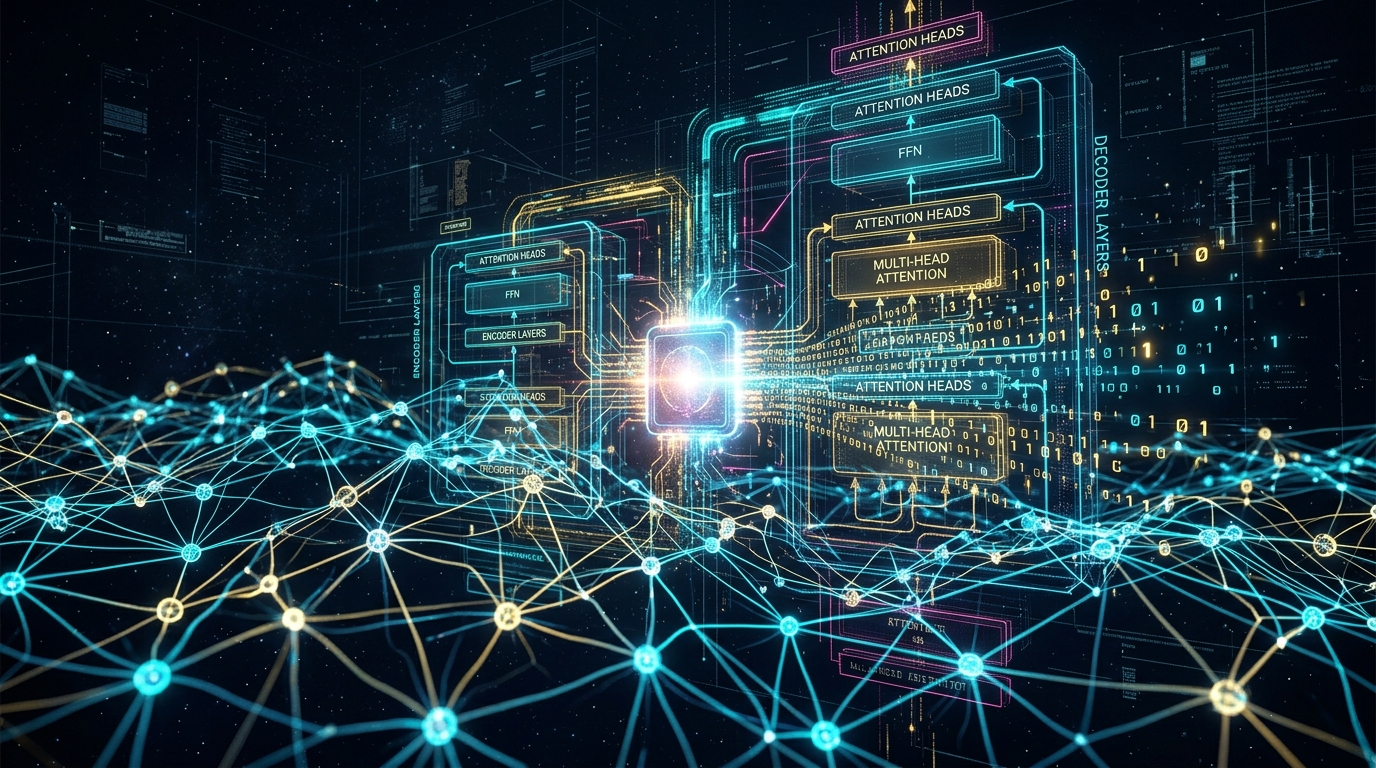
Transformer Architecture: Encoder and Decoder
The transformer consists of two main components:
1. Encoder
The encoder processes the input sequence and transforms it into a continuous representation. It consists of multiple layers of multi-head self-attention and feedforward networks stacked on top of each other.
2. Decoder
The decoder generates the output sequence from the encoded representation. It also uses multi-head attention but additionally attends to its own previous outputs to ensure coherence.
Types of Transformer-Based Models
1. Encoder-Only Models
These models use only the encoder component and are ideal for tasks like text classification, sentiment analysis, and information extraction. BERT (Bidirectional Encoder Representations from Transformers) is one of the most famous encoder-only models.
BERT’s bidirectional nature allows it to consider context from both directions, leading to a deeper understanding of language.
2. Decoder-Only Models
These models use only the decoder and are designed for text generation. GPT (Generative Pre-trained Transformer) and its successors (GPT-2, GPT-3, GPT-4) belong to this category.
GPT models can generate coherent and creative text, answer questions, write code, and even compose poetry. For a detailed understanding of how these models work, check out our article on Large Language Models (LLMs).
3. Encoder-Decoder Models
These models use both components and are suited for sequence-to-sequence tasks like machine translation and text summarization. T5 (Text-to-Text Transfer Transformer) and BART are prominent examples.
Advantages of Transformers
- Parallel Processing: Unlike RNNs, transformers can process all tokens in a sequence simultaneously, speeding up training.
- Long-Range Dependency Modeling: The attention mechanism excels at capturing relationships between distant tokens.
- Flexibility: Transformers can be adapted for a wide range of tasks (classification, generation, translation, etc.).
- Pre-training and Fine-Tuning: Models can be pre-trained on massive datasets and then fine-tuned for specific tasks with smaller datasets.
Challenges of Transformers
- Computational Expense: Training large transformer models (e.g., GPT-3 with 175 billion parameters) requires immense computational resources.
- Energy Consumption: The environmental cost of training and deploying these models is significant.
- Data Requirements: Pre-training demands access to vast text corpora.
- Hallucination: Large language models sometimes generate plausible-sounding but incorrect or fabricated information.
Comparing Neural Networks and Transformers
| Feature | Traditional Neural Networks (RNN/LSTM) | Transformers |
|---|---|---|
| Sequence Processing | Sequential (one after another) | Parallel (all at once) |
| Training Speed | Slow | Fast |
| Long-Range Dependencies | Limited (even with LSTM) | Strong (with attention) |
| Memory | Internal memory (in RNN/LSTM) | Attention mechanism |
| Main Application | Time series, short sequences | NLP, long texts |
| Computational Need | Moderate to high | Very high |
| Transfer Learning | Limited | Excellent (Pre-training & Fine-tuning) |
Real-World Business Applications of AI Architectures
AI architectures are transforming how businesses operate. Raahkar Agency, with its expertise in digital strategy and technical SEO, helps businesses harness these technologies:
1. Digital Marketing and Customer Analytics
Neural networks can identify customer behavior patterns and predict future purchases, enabling businesses to design more targeted marketing campaigns.
2. Automated Content Generation
Transformer-based large language models can generate articles, product descriptions, marketing emails, and social media captions, saving time and reducing costs.
3. Intelligent Customer Support
Chatbots powered by transformers can provide 24/7 customer support, understand natural language, and deliver coherent and accurate responses.
4. Sentiment Analysis and Opinion Mining
Using neural networks, businesses can analyze customer reviews on social media and review sites to understand public sentiment toward their brand.
5. Search Engine Optimization (SEO)
AI can assist with keyword analysis, content optimization, and predicting user behavior on search engines. Raahkar Agency uses advanced SEO techniques to help businesses rank higher in search results.

The Future of AI Architectures: Where Are We Headed?
The field of AI is rapidly evolving. Some emerging trends include:
- Multimodal Models: Models capable of processing text, images, audio, and video simultaneously. Examples include GPT-4 Vision and DALL-E.
- Reducing Computational Costs: Researchers are developing techniques such as pruning, quantization, and knowledge distillation to make models more efficient.
- Explainable AI (XAI): Efforts to build models whose decision-making processes can be understood, especially in sensitive areas like healthcare and law.
- Ethical and Responsible AI: Growing attention to ethical issues such as algorithmic bias, privacy, and responsible use of AI.
- Advanced Human-Machine Interaction: Developing more intuitive user interfaces that allow humans to interact with AI systems naturally.
Raahkar Agency’s Role in the AI Era
In today’s world, businesses must keep pace with technological advancements to remain competitive. Raahkar Agency offers specialized services in digital marketing, branding, business strategy, and SEO, helping companies leverage the potential of artificial intelligence. From designing intelligent marketing campaigns to optimizing content using advanced SEO techniques, Raahkar’s expert team is here to support you.
If you want to take your business to the next level and benefit from the latest technologies, contact us today.
Conclusion
Neural networks and transformers are the two pillars of modern artificial intelligence. Neural networks, inspired by the human brain, have been the foundation of many of today’s breakthroughs, while transformers, with their attention mechanism, have revolutionized natural language processing. Each of these architectures has its own strengths and challenges, but their combination and the development of new generations promise a bright future for AI.
Understanding these architectures is essential not only for researchers and developers but also for managers and entrepreneurs. With knowledge of how these technologies work, better strategic decisions can be made to steer businesses toward success.
Resources
For more information on AI architectures and their applications, explore these authoritative resources:
Deep Learning Book
Attention Is All You Need (Original Transformer Paper)
TensorFlow
PyTorch
Hugging Face

