Is Your Business Ready for the Next Wave? | Rahkar
A founder I spoke with recently put it this way: “Every time I think I’ve adjusted to the new normal, the normal changes again.” That sentence captures something most business owners feel right now but rarely say out loud. We are no longer living through a single crisis with a clear beginning and end. We are living through overlapping waves — economic, technological, and structural — that arrive faster than most organizations can absorb. The real question isn’t whether another wave is coming. It’s whether your business is built to ride it or be pulled under by it.
The Myth of “Things Going Back to Normal”
For decades, business leaders operated on a simple assumption: disruption is temporary. A recession hits, you cut costs, you wait it out, and eventually markets stabilize. That assumption no longer holds. Inflation cycles, energy price volatility, supply chain fragility, and rapid technological shifts are no longer isolated events — they are the operating environment itself. Businesses that keep waiting for “things to calm down” before rethinking their strategy are, in effect, waiting for a ship that isn’t coming.
This is precisely the mindset shift we explored in our article on Blue Ocean Strategy: businesses that wait for calmer waters lose the opportunity to build a better boat. The companies that thrive aren’t the ones with the most resources — they’re the ones with the clearest strategic identity and the fastest adaptation cycle.
Wave One: Economic Volatility Is the New Baseline
Global inflation, interest rate shifts, and currency instability have made financial planning dramatically harder for businesses of every size. The danger isn’t just rising costs — it’s that many companies are still measuring success with outdated metrics. Revenue growth on paper can mask shrinking margins in reality. If your pricing model, cost structure, and value proposition haven’t been reassessed in the last twelve months, there’s a strong chance your business is bleeding profitability without realizing it.
The fix isn’t simply “sell more.” It’s rethinking what you’re actually offering and whether your value proposition still matches what today’s more cautious, more price-sensitive customer actually needs.
Wave Two: Trust Has Become the New Competitive Currency
When consumers and businesses face financial uncertainty, purchasing behavior changes fundamentally. People stop chasing the cheapest option and start chasing the option they trust most. Brands that grew during easier economic times purely through discounts and paid advertising are now seeing rapid customer attrition — because they never built a genuine identity that customers would stay loyal to when budgets tightened.
This is the exact argument we made in our piece on Brand Persona: a brand without a defined personality, consistent voice, and clear promise is the first to be forgotten when customers start cutting spending. Today’s buyer has little patience for brands that feel interchangeable. They gravitate toward brands that feel like they understand them.
Wave Three: AI Is No Longer a Future Threat — It’s a Present Reality
For years, artificial intelligence was discussed as something on the horizon. That conversation is over. AI is now actively replacing specific business functions — first-draft content creation, basic customer support, data analysis, even preliminary design work — faster and cheaper than ever before. The relevant question for any business leader today isn’t “will AI affect my industry?” It’s: “How much of what I currently sell is something AI can now do faster and cheaper than I can?”
If the honest answer is “a lot,” your business model is exposed to real disruption. But if you can rebuild your value proposition around what AI genuinely cannot replicate — deep contextual expertise, long-term trust, human judgment, and truly personalized service — artificial intelligence stops being a threat and becomes your biggest operational advantage.
At Rahkar, we’ve applied this exact principle internally. We use AI tools to accelerate content production and visual design, but strategic decisions — brand positioning, narrative, and client strategy — remain deliberately human. If you want to understand how this balance should be reflected in your digital presence, our article on what website design really means is a good starting point.
Why Temporary Fixes Don’t Save Businesses
When leaders feel multiple pressures at once, the instinctive response is usually the same: cut marketing spend, freeze hiring, pause growth initiatives, and wait. These reactions treat symptoms, not root causes. Cutting marketing may preserve short-term cash, but it erodes brand presence exactly when competitors are fighting harder for the same shrinking attention. Cutting skilled talent reduces immediate payroll costs but strips the organization of the execution capacity it will need once conditions shift again.
The more effective response isn’t shrinking the business — it’s strategically redesigning it.

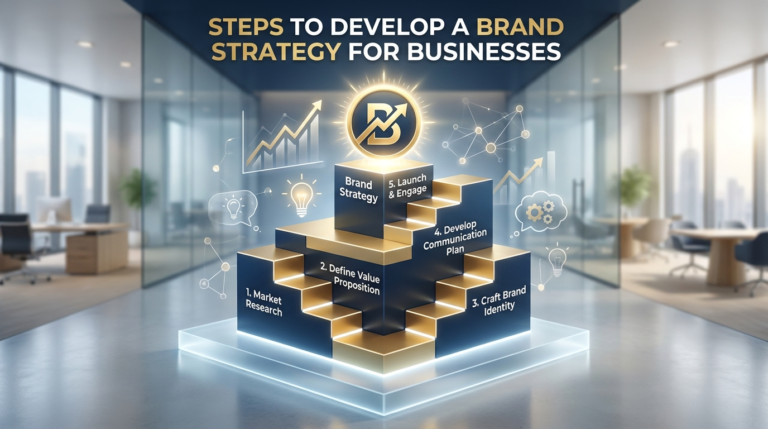
Five Practical Steps to Prepare for the Next Wave
1. Re-clarify Your Brand Positioning
In a chaotic market, an undifferentiated brand is the first casualty. You need absolute clarity on the position you hold in your customer’s mind — and why they should stay there — rather than redefining yourself through short-term discounts every quarter. Our article on brand positioning is a useful framework for this.
2. Rebuild Your Value Proposition Around Today’s Reality
The value proposition you wrote three years ago is probably outdated. Today’s customer prioritizes stability, price transparency, and reliability of delivery over almost anything else. Reassess whether your core promise still matches what your audience actually values right now.
3. Stop Competing Head-On — Find Your Blue Ocean
In a contracting market, price-based competition weakens everyone. Instead of fighting for a shrinking slice of an existing market, build a space where you have no direct competitor — the core idea behind Blue Ocean Strategy.
4. Use AI as a Tool, Not a Replacement for Strategy
Businesses ignoring AI entirely will lose on cost-efficiency. Businesses outsourcing everything to AI will lose their brand’s human identity. The right balance uses AI for speed and operational efficiency while keeping strategic thinking and brand storytelling firmly human-led.
5. Treat Your Digital Infrastructure as Core Business Strategy, Not IT
In an era where nearly every purchase decision starts with an online search, your website is no longer a digital business card — it’s the first real test of trust. A slow, outdated, or poorly optimized site erodes exactly the trust you’re trying to build with a more cautious buyer. Corporate SEO and professional web design aren’t optional anymore; they’re foundational.
Why This Matters More Than Ever Right Now
The businesses that survive periods of overlapping disruption aren’t necessarily the largest ones — they’re the ones that adapt fastest. Economic history consistently shows the same pattern: in every period of major disruption, a subset of businesses doesn’t just survive — they gain market share, precisely because competitors retreat while they move forward with clarity.
The real question isn’t whether disruption will end. It typically doesn’t — it simply changes shape. The real question is: does your business have a structure built to move through waves, or is it simply waiting for the water to calm down?
Final Thoughts
The next wave is coming, whether it arrives as renewed economic volatility, deeper AI disruption, or shifts we haven’t anticipated yet. Businesses that invest strategically today — in brand clarity, value proposition, and digital infrastructure — won’t just survive tomorrow. They’ll outpace competitors still reacting instead of preparing.
At Rahkar, this is the exact work we do with businesses: redefining brand positioning, rebuilding value propositions, and constructing digital infrastructure that builds trust under any market condition. If you’re wondering whether now is the time to prepare your business for what’s next — it is. Waiting until the wave arrives is already too late.
Sources
World Economic Forum – Future of Jobs Report
A global analysis of how AI and automation are reshaping labor markets and business operations in the years ahead.
Harvard Business Review – Leading Through Uncertainty
Research and strategic frameworks for leading organizations through periods of economic instability and disruption.
McKinsey & Company – The State of AI
In-depth global research on how organizations across industries are adopting and integrating artificial intelligence into core operations.
Rahkar | Related Articles
Explore Rahkar’s specialized article series on brand positioning, value proposition, and blue ocean strategy.
References:
Rahkar — Business Strategy Insights
Explore more on Blue Ocean Strategy and brand differentiation frameworks:
World Economic Forum
Global reports on business resilience and adapting to economic disruption:
McKinsey & Company
In-depth analysis on navigating economic uncertainty and strategic planning:
Harvard Business Review
Authoritative articles on the impact of AI on business and future-proof strategy:
International Monetary Fund (IMF)
Global economic outlook reports on macroeconomic instability and forecasts: